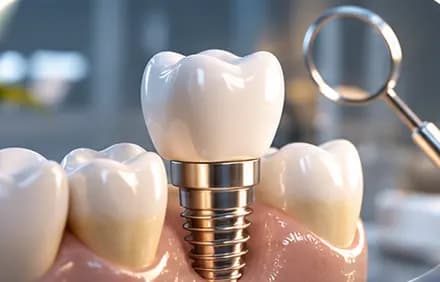
What All-on-4 and All-on-6 mean
In All-on-4 treatment, four implants are placed in one jaw and a fixed bridge with a full set of teeth is attached to them. The back implants are often placed at an angle so that they use more of the available bone, which can reduce the need for bone grafting. All-on-6 uses six implants. Which option suits you depends on the amount and quality of your bone, your bite and your general health, and only the dentist can decide that after examining you and your 3D (CBCT) scan.
The bridge is fixed: you do not take it out at night like a denture. It can be removed only by the dentist, for example for professional cleaning or repairs.
Who it may suit, and who may need a different plan
Full-arch treatment is usually considered for people who have lost most or all of their teeth in a jaw, or whose remaining teeth cannot be saved. It is not right for everyone. Bone loss, gum disease, uncontrolled diabetes, smoking and some medicines, such as those used for osteoporosis, can affect healing and the long-term result.
Smoking increases the risk that implants do not bond properly with the bone. UK dental teams strongly advise stopping before treatment and staying a non-smoker afterwards. Tell the clinic honestly about smoking, your medicines and your medical conditions.
How many trips and how long it takes
Most full-arch treatment abroad needs at least two trips. On the first, the dentist examines you, takes a 3D scan, removes any teeth that cannot be saved, places the implants and, if the implants are stable enough, fits a fixed temporary bridge, often within a few days. The implants then need time to bond with the bone, usually around three to six months. On the second trip the final bridge is made and fitted.
Bone grafting, a sinus lift or slow healing can add time and sometimes another visit. Ask for a written timeline, and plan your work and travel around it with some flexibility.
What to check in the treatment plan
- The number of implants in each jaw and why: four, six or another plan.
- The implant brand and system. Established systems with a long clinical track record make future repairs and spare parts easier to find, including in the UK.
- What the temporary bridge is made of and how long you will wear it.
- What the final bridge is made of, for example acrylic or composite on a metal framework, or ceramic such as zirconia, and why that choice suits you.
- Whether extractions, bone grafting, the 3D scan, temporary teeth and check-ups are included in the price, and what could cost extra.
- What the clinic’s guarantee covers, for how long, under which conditions (for example regular check-ups) and whether it covers repairs or only the implants.
- How follow-up works when you are back in the UK, and how you contact the dentist if something feels wrong.
How to check the dentist and the clinic
- Get the full name of the dentist who will place the implants and of the one who will make the bridge, if they are different.
- In Poland, ask for the dentist’s licence to practise (PWZ) number and check it in the register of the chamber of physicians and dentists.
- Ask how many full-arch cases the dentist treats each year and how they handle an implant that fails to heal.
- Ask to see examples of their own full-arch work, and how long ago those patients were treated.
- Make sure you speak to the dentist yourself before you commit, and get the plan and the price in writing.
Before you travel
- Ask your UK dentist for your dental records and recent X-rays; they can also give a second opinion on the plan.
- Send the clinic your medical history and a list of your medicines, including blood thinners and osteoporosis medicines.
- Arrange insurance that covers planned treatment abroad. Standard travel insurance usually does not, and the UK GHIC card does not cover treatment you travel to have.
- Plan soft food for the first weeks after surgery and some time off work after the first trip.
Looking after a full-arch bridge for the long term
Implants do not decay, but the gum and bone around them can become inflamed and infected if plaque builds up, which can lead to losing an implant. Daily cleaning matters even more than with natural teeth. The clinic should show you how to clean under the bridge, usually with a soft brush, interdental brushes and often a water flosser.
Plan regular check-ups and professional cleaning, either with the clinic or with a UK dentist willing to look after implants placed abroad. Ask for a treatment summary in English with the implant brand, sizes and positions, and the bridge material, so any dentist can help you later.
If something goes wrong
Contact the treating clinic first if you have pain that gets worse, swelling, a loose implant or a broken bridge. Agree before treatment how problems are handled and who pays for travel if you need to go back. In the UK, an NHS or private dentist can give urgent care, but corrective work on implants placed abroad is usually private and may be complex. Our aftercare guide explains the steps.
Full-arch dental treatment in Poland with MED Travel Connect
Our partner Dentineo in Gdańsk offers All-on-4 and All-on-6 treatment, with digital X-rays and 3D scanning on site. We collect your X-rays and records, pass them to the dentist for assessment, help with dates, travel and accommodation for each trip, and stay your UK-based contact throughout. Only the dentist decides which treatment is right for you.
Read about dental care in Poland and the cost of dental implants in Poland, or book a free call to talk it through.
Frequently asked questions
What is All-on-4?
All-on-4 replaces all the teeth in one jaw with a fixed bridge held by four implants. The bridge stays in place and is removed only by the dentist. All-on-6 uses six implants.
How many trips do I need for All-on-4 abroad?
Usually at least two. Implants and a temporary bridge are placed on the first trip, and the final bridge is fitted on the second, usually around three to six months later. Bone grafting or slow healing can add time.
Will I have teeth straight after the surgery?
Often yes: if the implants are stable enough, a fixed temporary bridge is fitted within a few days. If not, the dentist will explain the alternative, such as a temporary denture while the implants heal.
Can I have All-on-4 if I smoke?
Smoking increases the risk that implants do not bond with the bone and slows healing. UK dental teams strongly advise stopping before treatment and staying a non-smoker afterwards. Tell the dentist honestly so they can assess your risk.
Who looks after my implants when I am back in the UK?
Agree follow-up with the clinic before treatment, and find a UK dentist willing to check and clean implants placed abroad. Bring a treatment summary with the implant brand and the bridge material.
This guide is general information, not medical advice. MED Travel Connect provides travel coordination and patient support. Only the treating clinician can assess suitability, recommend treatment and explain the risks for you.